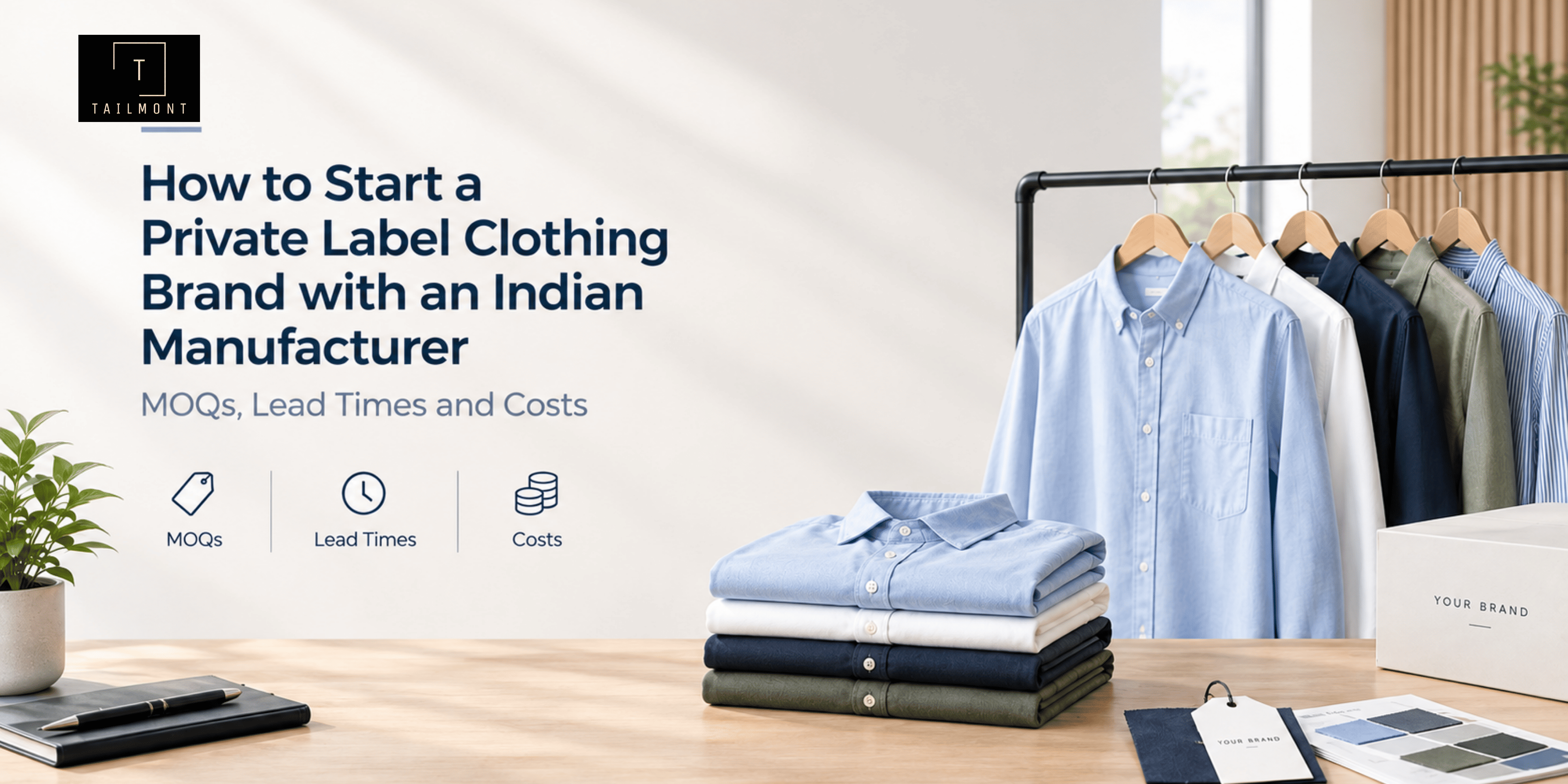
How to Start a Private Label Clothing Brand with an Indian Manufacturer: MOQs, Lead Times and Costs
A practical guide for importers, wholesalers, distributors, sellers and new brands in the UK, Netherlands and Europe
Starting a clothing brand used to mean either a large design team or expensive local production. Today, a growing number of UK, Dutch and European entrepreneurs, retailers and online sellers launch brands by partnering with a specialist manufacturer in India. The reasons are strong: cotton-rich supply chains, skilled labour, flexible customisation and competitive pricing.
This guide walks you through the whole process: choosing products, understanding MOQs, planning lead times, calculating real costs and avoiding the mistakes that cost new brands time and money.
Why Source Private Label Clothing from India?
India is one of the world’s largest producers of cotton and has deep expertise in knitwear and woven garments. For brands in the UK and Europe, the advantages include:
Vertically integrated supply: from yarn and fabric to cutting, stitching, finishing and packing, much of it can be done within one country.
Customisation: fabrics, GSM, fits, labels, trims, embroidery and printing can all be tailored to your brand.
Value for money: strong quality at prices that leave room for healthy retail margins.
Improving trade terms: the India–UK Comprehensive Economic and Trade Agreement (CETA) entered into force on 15 July 2026, and textiles and clothing receive duty-free access across 1,143 tariff lines. The EU also concluded its own trade agreement with India in January 2026, with entry into force expected no earlier than early 2027. Building a supplier relationship now means you are ready when the EU advantage arrives.
Important: preferential tariff treatment under the UK deal depends on whether a consignment can demonstrate origin under the agreement’s rules. The benefit is not automatic, so work with a manufacturer who understands origin documentation.
What Is Private Label Clothing?
Private label means a manufacturer produces garments that are sold under your brand name. You decide the design direction, fabric, fit, labels and packaging, and the manufacturer handles production. There are two common models:
Customised private label: you adapt a manufacturer’s proven base styles (for example, a round neck tee or polo) with your own fabric, colours, labels and packaging. This is faster and lower risk, and it is ideal for first-time brands.
Fully custom (cut-and-sew): you supply a tech pack for an original design, and the factory develops patterns and samples from scratch. It takes longer and usually needs higher volumes.
Step 1: Define Your Brand and Product Range
Before contacting any manufacturer, get clear on three things:
Your customer: streetwear shoppers, corporate buyers, premium basics, smart-casual professionals?
Your price position: budget, mid-market or premium. This determines fabric quality and construction.
Your starter range: most successful new brands launch small and focused.
A smart starter range for UK and European markets might draw from these categories:
|
Product |
Best for |
Typical positioning |
|
Round neck T-shirts |
Everyday basics, promo and retail staples |
Steady, repeat-order volume |
|
Oversized T-shirts |
Streetwear and fashion-led brands |
Fast-growing category, higher perceived value |
|
Polo T-shirts |
Smart-casual, corporate, golf and leisure |
Strong margins and repeat buyers |
|
Casual shirts |
Lifestyle and menswear brands |
Versatile, year-round |
|
Formal shirts |
Workwear, tailoring and premium menswear |
Higher price point, quality-sensitive |
Start with two or three core styles in a limited colour palette. Expand once you see what sells.
Step 2: Choose Fabric and Specifications
Fabric choice drives both quality and cost. Key decisions include:
Fibre: 100% cotton, cotton-polyester blends, or premium combed and ring-spun cotton.
GSM (fabric weight): lighter weights (around 160–180 GSM) suit classic tees. Heavier weights (around 200–250 GSM) give the structured drape that oversized and streetwear styles need. Polos typically use piqué knit.
Finish: pre-shrunk, bio-washed, enzyme-washed or soft-finished fabrics improve feel and reduce shrinkage.
Fit: regular, slim, relaxed or oversized, with size grading for UK and EU sizing.
Ask for fabric swatches before you commit. Touch and drape matter far more than a product description.
Step 3: Prepare a Tech Pack (or Brief)
A tech pack is the instruction manual for your garment. A good one includes:
Technical sketches (front, back, details)
Measurements and size chart with tolerances
Fabric, GSM and colour references (Pantone codes if possible)
Stitching and construction details
Label, trim and packaging specifications
Print or embroidery artwork with placement and size
Don’t have a full tech pack? A reputable manufacturer can work from reference garments, sketches or photos, and help you develop the specifications.
MOQs: Minimum Order Quantities Explained
MOQ is the smallest quantity a manufacturer will produce per style (and often per colour). It exists because cutting, setup, fabric dyeing and production planning all carry fixed costs. Typical industry ranges are shown below. Always confirm exact figures with your manufacturer.
|
Order type |
Typical MOQ (per style/colour) |
|
Stock designs with your label and packaging |
Lower, often a few hundred pieces |
|
Custom fabric, fit or colour |
Moderate, commonly 300–500+ pieces |
|
Fully custom design with dyed-to-match fabric |
Higher, often 500–1,000+ pieces |
How to work with MOQs as a new brand
Limit variety, not volume: 500 pieces of one style is usually easier than 100 pieces across five.
Use size runs smartly: MOQs typically apply to the total per style, so you can split across S–XXL.
Start with fewer colours: each extra colour can add its own minimum.
Plan reorders: MOQs are often more flexible once a relationship is established.
Lead Times: From Idea to Delivery
Realistic planning prevents missed launch dates. A typical timeline looks like this:
|
Stage |
Typical duration |
|
Brief, quotation and fabric selection |
1–2 weeks |
|
Sample development |
1–3 weeks |
|
Sample revisions and approval |
1–2 weeks |
|
Bulk fabric sourcing, dyeing and cutting |
1–3 weeks |
|
Bulk production, stitching and finishing |
3–5 weeks |
|
Quality control, packing and dispatch |
1 week |
|
Sea freight (India to UK/EU port) |
Roughly 3–5 weeks |
|
Customs clearance and inland delivery |
3–7 days |
Overall, plan for around 12–18 weeks from first enquiry to goods on your shelf for a new product. Repeat orders are typically much faster because samples and patterns are already approved. Air freight can cut transit to under a week, but at significantly higher cost.
Tip: work backwards from your launch date and add a buffer of two to three weeks. Shipping disruptions and festival-season production peaks can affect schedules.
Costs: What You’ll Actually Pay
Many new brands focus only on the price per piece. The real cost has several layers.
1. Product cost (FOB price)
FOB (Free On Board) is the price per garment at the Indian port, covering fabric, cutting, stitching, trims, basic labels and packing. It depends on fabric quality, GSM, construction complexity and order size. Larger orders reduce the per-piece price.
2. Customisation costs
Printing (screen, DTG, puff and others) or embroidery
Custom woven or printed neck labels, hang tags and care labels
Branded polybags, boxes or packaging
3. Development costs
Sample charges (some manufacturers credit these against bulk orders)
Courier costs for samples
Pattern development for fully custom designs
4. Logistics and import costs
International freight and insurance
Customs clearance and broker fees
Import duty (check your origin eligibility)
VAT (usually recoverable for VAT-registered businesses)
Inland delivery to your warehouse
Illustrative landed cost example
This is a simplified example, not a quotation. Actual figures vary widely.
|
Item |
Illustration (1,000 oversized tees) |
|
FOB product cost (example: $5.50 per piece) |
$5,500 |
|
Custom labels and packaging |
$300–$500 |
|
Sea freight and insurance |
$400–$900 |
|
Customs broker and handling |
$150–$300 |
|
UK import duty |
Potentially 0% if CETA origin requirements are met |
|
EU import duty (before any FTA takes effect) |
Check the current rate for your product code |
|
Approx. landed cost per piece |
Around $6.50–$7.50 |
Your retail price should typically be a multiple of landed cost. Many apparel brands target 2.5× to 4× across their wholesale-to-retail margin structure, so a tee landing at $7 can retail comfortably in the mid-to-upper range.
Budget tip: keep 10–15% of your total budget as a contingency for samples, rework, freight fluctuations and unexpected fees.
Payment Terms
Common arrangements with Indian manufacturers include:
Advance deposit (commonly 30–50%) to start production, with the balance before shipment or against documents
Letter of Credit (LC) for larger or established relationships
Bank wire transfer (T/T), the most common method
Always agree payment terms in writing, and use a formal proforma invoice and purchase order.
Quality Control: Protect Your Brand Reputation
Your brand name is on every garment, so quality control is non-negotiable.
Approve a pre-production sample and keep a signed “golden sample” as the benchmark.
Agree an AQL standard (Acceptable Quality Limit) for inspections.
Check at three stages: fabric inspection, in-line production checks and final pre-shipment inspection.
Test critical specifications: shrinkage, colour fastness, measurements, stitching strength and label accuracy.
Confirm compliance: ask for relevant certifications and chemical-safety compliance for the UK and EU (such as REACH requirements and recognised standards like OEKO-TEX, where applicable).
Shipping, Incoterms and Customs
Know what each term means before you sign:
FOB: the manufacturer delivers to the Indian port; you manage freight and everything after.
CIF: the manufacturer includes freight and insurance to your destination port.
DDP: the seller handles everything including import duties. This is less common and priced accordingly.
For your first order, many brands choose FOB or CIF with a trusted freight forwarder. Make sure your commercial invoice, packing list, bill of lading and origin documentation are accurate. Errors cause delays and extra charges.
Common Mistakes New Brands Make (And How to Avoid Them)
Starting too broad. Too many styles, colours and sizes dilute your budget. Launch focused.
Skipping samples to save time. A sample costs far less than a bad bulk order.
Choosing on price alone. The cheapest quote often hides weaker fabric or inconsistent quality.
Vague specifications. “Premium feel” is not a spec. Define GSM, fit and tolerances.
Ignoring lead times. Missing a season can cost more than paying for faster shipping.
Overlooking compliance and labelling. UK and EU garments need correct fibre content, care and origin labelling.
Not planning reorders. Agree early on how quickly bestsellers can be replenished.
Checklist: Questions to Ask Before Choosing a Manufacturer
What are your MOQs per style and per colour?
Can you provide fabric swatches and physical samples?
What is the sampling cost and timeline?
What customisation do you offer (labels, trims, printing, embroidery, packaging)?
What quality-control process and AQL standard do you follow?
What certifications do you hold?
Can you support UK/EU export documentation, including origin paperwork?
What are your payment terms and typical production lead time?
Can you share references or experience with UK and European buyers?
Launch Your Brand with TailMont
TailMont partners with importers, distributors, wholesalers, retailers and emerging brands across the UK, the Netherlands and Europe. We manufacture premium round neck T-shirts, oversized T-shirts, polo T-shirts, casual shirts and formal shirts, with private label and customisation options covering fabric and colour selection, fits, custom labels, trims, printing, embroidery and packaging.
Our approach is built on carefully selected fabrics, rigorous quality checks at every stage, consistent and reliable supply, and responsive, transparent communication from first enquiry to final delivery.
Ready to build your brand?
Tell us your product ideas, target market and expected quantities, and our team will respond with guidance on specifications, MOQs, samples and lead times.
Enquire for Customisation | Explore Our Products | info@tailmont.com
Frequently Asked Questions
What is the minimum order quantity for private label clothing from India?
It depends on the manufacturer, product and level of customisation. Stock designs with your branding generally have lower MOQs, while custom fabrics and fully original designs need higher quantities. Ask for MOQs per style and per colour.
How long does it take to produce private label clothing in India?
For a new product, plan for around 12–18 weeks from enquiry to delivery, including sampling, production and sea freight. Repeat orders are usually faster.
How much does it cost to start a private label clothing brand?
Costs vary by product, fabric and volume. Budget for product cost, customisation, samples, freight, duties, VAT and a contingency. A small, focused first order of one to three styles is a sensible starting point.
Do I need a tech pack?
A tech pack is ideal, but not always required to start. A good manufacturer can work from reference garments, sketches or detailed briefs and help you finalise specifications.
Can I get samples before placing a bulk order?
Yes, and you should. Always approve a pre-production sample before bulk production begins.
Is importing clothing from India to the UK duty-free now?
Under the India–UK CETA, in force since 15 July 2026, textiles and clothing can qualify for zero-duty access, but only if the goods meet the agreement’s origin rules and documentation requirements. Check current rules with your customs adviser or broker.
What about importing into the EU?
The EU–India agreement has been concluded but is not yet in force, so standard EU duty rules apply for now. Check the current rate for your product’s commodity code.
Can I import different clothing categories in a single shipment?
Yes. Many buyers combine tees, polos and shirts in a mixed order, subject to each style meeting the manufacturer’s MOQ.