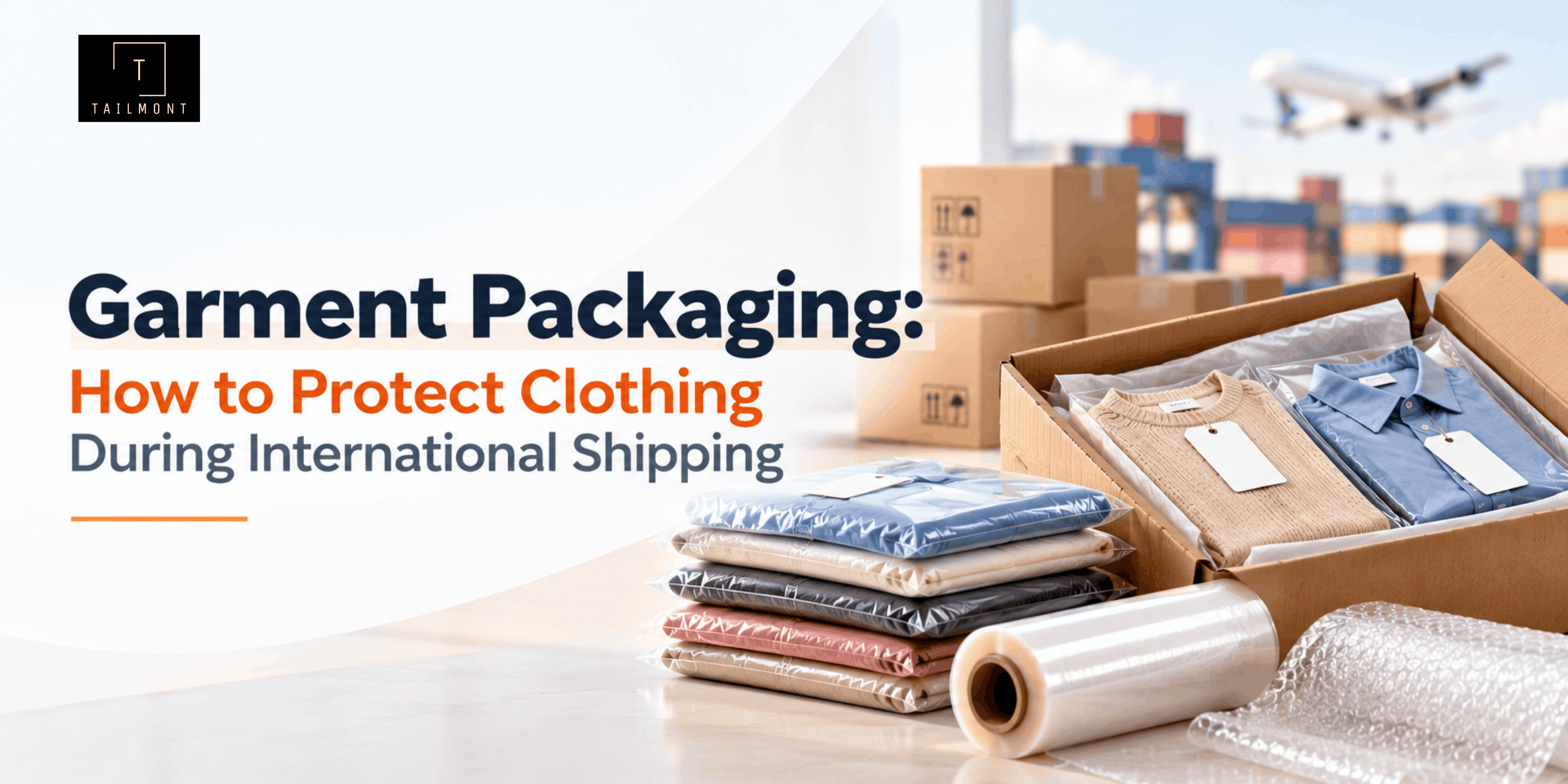
Garment Packaging: How to Protect Clothing During International Shipping
A shirt that leaves the factory perfectly pressed can arrive at a distribution center creased, musty, or stained. It usually isn’t the garment’s fault. It’s the packaging. Ocean freight can take four to six weeks, with temperature swings, humidity, stacking pressure, and several handling points along the way.
Good garment packaging for international shipping is not about adding more material. It’s about choosing the right protection for the fabric, the route, and the buyer’s receiving requirements. This guide covers what exporters, merchandisers, and logistics teams should know to cut damage claims and rejected shipments.
Why Garment Packaging Matters in Export Shipping
Apparel is one of the most claim-prone categories in global freight. Unlike machinery or electronics, clothing rarely breaks. It gets damaged in quieter ways: moisture absorption, mold, color transfer, crushed cartons, torn poly bags, and wrinkles that cannot be corrected without re-pressing.
For buyers, these problems translate into delayed floor sets, chargebacks, and lost trust. For exporters, they mean credit notes and repeat orders at risk. Sound garment packaging for export protects margin as much as it protects product.
Common Causes of Damage During Transit
Most apparel damage traces back to a handful of causes:
- Moisture and condensation inside the container, especially on routes crossing climate zones
- Weak cartons that collapse under stacking load
- Poor carton fit, where loose goods shift and crease or overfilled cartons bulge and split
- Unsealed or thin poly bags that tear and let in dust or water
- Dye migration between dark and light garments packed together
- Rough handling during loading, transshipment, and unloading
Knowing which risks apply to your shipment helps you spend on protection where it counts.
Core Garment Packaging Methods
There is no single correct approach. The right choice depends on garment type, order volume, and the buyer’s retail model. The three main garment packaging methods are described below.
Flat Packing
Garments are folded, placed in individual poly bags, and packed flat into cartons. This is the most common method for T-shirts, knitwear, underwear, and basic woven items. It uses container space efficiently and keeps freight cost low. The trade-off is that folded garments can develop crease lines, so fold technique and tissue or cardboard inserts matter for structured items like dress shirts.
Hanger Packing and Garments on Hangers (GOH)
Premium items such as jackets, dresses, suits, and blouses are often shipped on hangers inside cartons or in garment-on-hanger containers. This keeps them retail-ready and wrinkle-free, but it takes more space and costs more to ship. Each garment should be covered with a poly cover, and hangers must be secured so they cannot slide and tangle during transit.
Roll Packing
Used mainly for denim, casualwear, and some knits, rolling reduces creasing and saves space. It suits fabrics that tolerate being tightly wound, and it is less suitable for delicate or heavily embellished pieces.
Choosing the Right Materials for Protective Packaging for Clothing
Material selection is where many packing specs go wrong. Protective packaging for clothing should be matched to the garment’s value and sensitivity.
Poly Bags and Inner Packaging
Individual poly bags keep garments clean and provide a first moisture barrier. Use bags thick enough to resist tearing, and make sure they are sealed. Bags with larger openings generally need a printed suffocation warning to meet safety regulations in markets such as the US and EU, so check destination rules before printing. Tissue paper, cardboard collar inserts, and butterfly clips help preserve shape on shirts and blouses.
Export Cartons
Standard retail cartons are not built for a 6,000-nautical-mile journey. Export carton packaging for apparel should use corrugated board with enough burst and edge-crush strength to handle stacking in a container. Many exporters use 5-ply boards for heavier or high-value shipments. A few practical points:
- Match carton size to the product so there is no empty space or overpacking
- Keep carton weight manageable, commonly under 20 kg, for safe manual handling
- Seal with quality tape, applying it along all seams, and use strapping where the buyer requires it
- Reinforce corners and use edge protectors on palletized cargo
Pallets and Wrapping
When cartons ship palletized, wood must comply with ISPM 15, the international standard for treating wooden packaging against pests. Cartons should be stacked in an interlocking pattern, stretch-wrapped, and kept within the pallet footprint, since overhang is a leading cause of crushed edges.
Moisture Protection for Garments
Moisture is the single biggest threat to apparel on ocean routes. Cotton and other natural fibers absorb humidity readily, and a closed container can experience “container rain,” where condensation forms on the ceiling and drips onto cargo as temperatures change.
Effective moisture protection for garments works in layers:
- Make sure goods are dry before packing. Garments and cartons packed with residual moisture will trap it inside.
- Use sealed poly bags as the primary barrier.
- Add desiccants such as silica gel or clay-based packs inside cartons for longer or humid routes. Avoid anti-mold sachets containing dimethyl fumarate (DMF), which is prohibited in the EU because of skin sensitization risks.
- Line containers with absorbent kraft paper or desiccant strips when the route warrants it.
- Pack cartons tightly and stack properly so there is little airflow carrying humid air against the cargo.
- Choose container loading carefully, avoiding contact between cartons and container walls where possible.
For leather trims, wool, and light-colored garments, extra care is worthwhile. Mold stains and color damage are almost impossible to reverse.
Meeting Apparel Export Packaging Standards
Buyers rarely leave packaging to the supplier’s discretion. Most major retailers and brands issue their own routing and packing guides. Understanding apparel export packaging standards early prevents costly repacking at the port or distribution center.
Buyer and Retailer Requirements
Typical requirements include:
- Specified polybag dimensions, material, and warning labels
- Carton size limits and maximum weight per carton
- Solid-size or solid-color packing rules, or defined assortment ratios
- Carton labels with barcodes, such as GS1-128 or SSCC labels
- Pallet configuration, height limits, and labeling
Always work from the latest version of the buyer’s guide, and confirm any deviation in writing before production.
Labeling and Documentation
Clear shipping marks on cartons help freight handlers and customs authorities identify cargo quickly. Include the buyer’s PO number, style, color, size breakdown, quantity, carton number, gross and net weight, and country of origin. Accurate labeling also supports smoother customs clearance and reduces the chance of misrouted cartons.
Many exporters also test pack designs against recognized transit protocols, such as ISTA procedures, before committing to a large order. A drop and vibration test costs little compared to a container of damaged goods.
A Practical Packing Checklist for Exporters
Before a shipment leaves the factory, confirm the following:
- Garments are fully dry, pressed, and passed through final inspection
- Dark and light colors are separated, and color-fastness issues are flagged
- Poly bags are sealed and carry required warnings
- Cartons are the correct size, strength, and sealed on all seams
- Desiccants are added where the route or season calls for them
- Labels match the packing list and buyer’s guide
- Pallets are ISPM 15 compliant, wrapped, and within height limits
- Container condition is checked: clean, dry, and free of odors or leaks
Working With the Right Logistics Partner
Packaging does not end at the factory gate. Freight forwarders, consolidators, and carriers influence how cartons are loaded, braced, and handled. Share your packaging specifications with your logistics partner, ask about transit times and transshipment points, and consider cargo insurance for high-value or time-sensitive orders. A forwarder with apparel experience can also advise on seasonal risks, such as monsoon humidity or winter condensation on North Atlantic routes.
Why Choose Tailmont
Tailmont, operated by Swapthrough Impex Pvt. Ltd. in Bengaluru, is a B2B men’s apparel manufacturer and exporter. We supply importers, wholesalers, retailers, and private-label brands in the UK, the Netherlands, Europe, and the USA with T-shirts, polos, and casual and formal shirts.
We confirm packaging, labeling, and specifications with you before production, so your shipment arrives ready for your warehouse and meets your market’s requirements. You work directly with our team, and every detail is agreed in writing.
Ready to Build Your Next Range?
Get in touch with our team today to discuss B2B apparel manufacturing, customization, and export opportunities.
Email: info@tailmont.com
Phone: +91 89715 29797
Website: https://tailmont.com/
LinkedIn: https://www.linkedin.com/company/tailmont