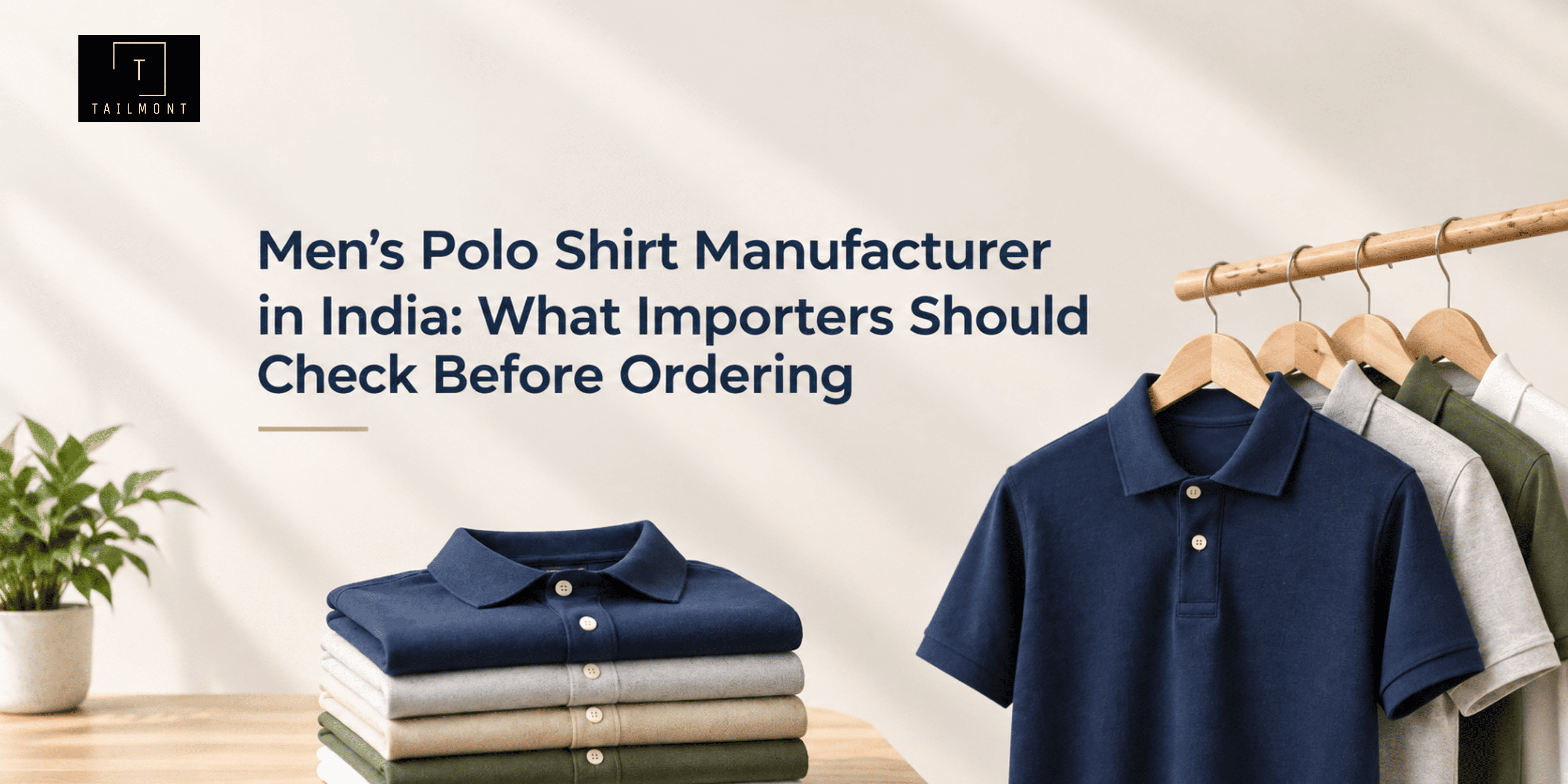
A polo shirt looks simple until it is produced 5,000 times. The collar has to sit the same way on every piece, the placket has to stay flat after washing, and the colour on a navy batch has to match the navy you approved. Buyers who source a polo shirt manufacturer in India on price alone often discover these details only after the goods arrive.
This guide explains what importers, wholesalers and brand buyers should verify before placing a bulk order for men’s polos, including common quality issues, sampling checks and questions to ask before requesting a quotation.
Why Polo Shirts Are Harder to Source Than Plain T-Shirts
A round neck T-shirt has a neckline, two sleeves and a hem. A polo adds a collar, placket, buttons, cuffs or sleeve ribs, and often embroidery or other branded details.
Each additional component creates another point where measurements, shade or construction can vary. This is why sourcing from a reliable polo T-shirt manufacturer requires more than comparing prices. Buyers should compare specifications, samples and production processes.
The Polo Shirt Checklist for Importers
| Component | What to verify | How to approve it |
| Fabric | Fibre content, construction (piqué or jersey) and GSM. Confirm the surface and hand-feel match your target. | Approve a physical fabric swatch and record GSM with an agreed tolerance. |
| Collar | Shape, stand height, symmetry and whether it keeps its shape after washing. | Check the pre-production sample after a wash cycle. |
| Placket and buttons | Placket length, stitching, button type, button-hole quality and attachment strength. | Measure against the spec and tug-test the buttons. |
| Sleeves and cuffs | Sleeve length, cuff or rib recovery and seam finish. | Measure against the size chart and test rib recovery. |
| Colour | Shade accuracy and consistency between the body, collar and trims. | Approve against a physical colour reference under consistent lighting. |
| Embroidery or print | Placement, size, stitch density, backing and fabric puckering. | Approve placement using exact measurements from a fixed point. |
| Shrinkage and twist | Dimensional change after washing and side-seam twisting. | Wash-test a sample and re-measure it. |
| Labels and packing | Neck label, care and content label, folding and polybag requirements. | Confirm wording, placement and packing instructions in writing. |
Fabric and Construction: Piqué, Jersey and Weight
Polo shirts are commonly made in piqué, a textured knit, or plain jersey. Piqué tends to hold its shape and has a textured surface, while jersey is smoother and lighter. Neither is automatically better. The right choice depends on your price point, season and customer.
Whichever fabric you choose, include the fibre, construction and GSM in the specification. A polo shirt manufacturer in India cannot provide a like-for-like quotation when the brief only says “premium cotton.”
For buyers comparing wholesale polo shirts India suppliers, quotations should be based on the same fabric, GSM, measurements, branding and packaging specifications. A lower price may reflect a lighter fabric or simpler construction.
A Higher GSM Does Not Necessarily Mean Higher Quality
A higher GSM does not necessarily mean higher quality. Yarn, construction, finishing and stitching also affect the final garment.
This is why buyers should evaluate the complete specification rather than selecting a polo based only on fabric weight.
Collar Quality: The Detail Buyers Notice First
Collars are one of the first details buyers notice. Ask how the collar is constructed, what stabilises it and how it behaves after repeated washing.
If the collar uses a different fabric or colour from the body, such as a rib or contrast collar, check that its shade and shrinkage match the specification. These checks are particularly important when working with a men’s polo shirt supplier, because collar shape and recovery need to remain consistent throughout a bulk order.
Common Mistakes When Ordering Polo Shirts
- Approving a sample only when new. Collar curl, shrinkage and colour issues can appear after washing.
- Leaving embroidery placement vague. “Left chest” can mean different positions. Provide an exact measurement.
- Not specifying tolerances. Without agreed tolerances for chest, length and GSM, there is no objective way to judge a shipment.
- Comparing quotes on different specifications. A cheaper polo may use a lighter fabric or simpler collar.
- Treating labelling as an afterthought. Fibre-content and care-labelling requirements differ across the UK, EU and US and should be checked for the target market.
How to Evaluate a Polo Shirt Manufacturer
Before requesting a quotation, ask the supplier:
- Do you regularly manufacture polos, and in which fabrics?
- How is a sample developed, and how long does it take?
- What do you inspect, and at which stages of production?
- How do you maintain collar shape, colour and measurements across batches?
- Which customisation options are available for collars, cuffs, trims and embroidery?
- Which export documents and shipping methods do you provide?
- Which export registrations can you show, such as an Import Export Code and GST registration?
These questions help buyers evaluate a polo shirt manufacturer before moving from sampling to bulk production. They are also useful when comparing a polo shirt exporter India supplier with other international sourcing options.
How TailMont Approaches Polo Shirts
TailMont is a Bengaluru-based men’s apparel manufacturer and exporter in India, supplying polo shirts and other menswear to importers, wholesalers, retailers and private-label brands across the USA, UK and Europe.
For custom polo shirts bulk orders, buyers can specify fabric, GSM, colour, fit, collars, cuffs, stitching and trims. TailMont also supports custom labels, neck labels, hangtags, packaging, printing and embroidery.
For brands sourcing private label polo shirts, specifications are finalised before sample approval and bulk production.
Quality checks cover fabric, cutting, stitching, measurements, colour consistency, finishing and packaging. Samples typically take 7–14 days, while bulk production takes 30–60 days.
TailMont has a 500-piece MOQ and supports international shipping through sea freight, air freight and express courier for samples.
Why Choose TailMont as a Polo Shirt Manufacturer in India?
- Export-Focused Manufacturing — Serving importers, distributors, wholesalers and retailers across the US, UK and Europe.
- Flexible Customisation — Fabric, colour, fit, GSM, stitching, trims, labels, printing, embroidery and packaging.
- Sample-First Process — Specifications are finalised before sample approval and bulk production.
- Quality Checks — Inspection across fabric, measurements, stitching, colour, finishing, branding and packaging.
- 500-Piece MOQ — A defined MOQ for B2B apparel orders.
- Reliable Production Timelines — Typical samples in 7–14 days and production in 30–60 days, with schedules confirmed before production.
- Export Documentation Support — Documentation prepared according to destination-market requirements.
Conclusion
A good polo order starts with a written specification and a sample you have washed, measured and compared against it. If you are comparing suppliers, use the checklist above on every sample you receive and ask each polo shirt manufacturer in India the same questions.
This approach is useful whether you are sourcing private label polo shirts, comparing a men’s polo shirt supplier, or looking for custom embroidered polo shirts wholesale India.
Planning a polo range? Discuss your polo shirt requirements with TailMont’s team and share your fabric, fit, branding and quantity details to start the conversation.
FAQs
1. What should I check on a polo shirt sample?
Check fabric weight and construction, collar shape, placket and button quality, measurements against the size chart, colour, embroidery placement and wash performance.
2. Is piqué better than jersey for polos?
Neither is universally better. Piqué is textured and tends to hold shape, while jersey is smoother. Choose according to price point, season and customer expectations.
3. Can polo collars, cuffs and trims be customised?
TailMont’s FAQ states that collars, cuffs, trims and stitching details can be customised, along with fabric, colours, fit and GSM.
4. How long does sampling take?
TailMont states typical sample development of 7–14 days. Timelines vary by style and are confirmed before production begins.
5. Can I add my own branding to polos?
TailMont states that private-label and custom branding, including labels, hangtags, packaging, printing and embroidery, can be supported, with specifications approved at the sampling stage.
6. What should I ask before placing a bulk polo order?
Ask about fabric specifications, GSM, sampling, quality checks, measurement tolerances, customisation, production timelines, export documentation and MOQ before confirming the order.